


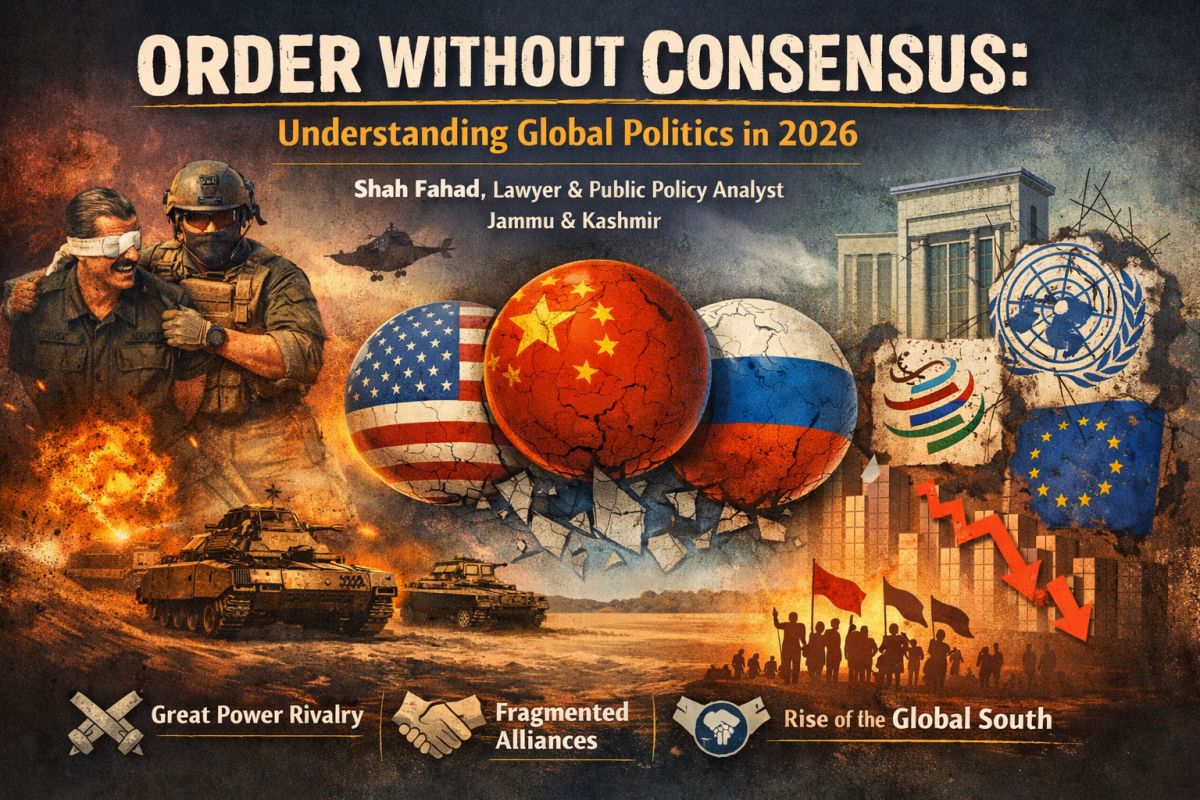
In a dramatic escalation, on January 3, 2026, U.S. forces carried out a military operation in Venezuela that resulted in the capture of President Nicolás Maduro and his wife. U.S. officials intend to try Maduro on charges including narco-terrorism in U.S. courts. This has been described by U.S. political leaders as part of broader efforts to counter threats linked to drug trafficking and hostile governance.
The world order in 2026 can be defined as a fragmented, contested, transitional and transactional order characterised by multipolar power distribution, weakening global governance, selective multilateralism and intensified great-power rivalry.
Order Without Consensus: Why “World Order” Is Difficult to Define In 2026
Unlike earlier periods, 2025 and 2026 do not fit neatly into one category. The cold war (1945-1991) period was defined as a bipolar world order led by USA and USSR. Between 1991 and 2008 the world witnessed the hegemonic rise of USA and its liberal ideology creating a unipolar world order. Post 2008 the idea of emerging multipolarity became the main focus, especially with the rise of China as a challenger to USA and middle power countries like India.
Around 2015 the world order witnessed transition and fragmentation moving towards a hybrid model. Events like Russia’s annexation of Crimea in 2014, followed by its invasion of Ukraine in 2022, the rise of protectionism and deglobalisation (Brexit by Britain in 2020, America first policy in USA under Donald Trump) and the recent tariff wars between USA and India have highlighted the changing world order.
USA has also announced withdrawal of the United States from 66 international organizations that no longer serve American interests and to cease participating in and funding 35 non-United Nations (UN) organizations and 31 UN entities that operate contrary to U.S. national interests, security, economic prosperity, or sovereignty.
Joseph Nye describes the contemporary world order as a 3D Chessboard:
- Unipolar in military power (dominated by USA)
- Multipolar in economic power (emergence of China, India etc.)
- Diffused in cultural and societal power (shared among MNCs, media, religious groups etc.)
The old order is declining, but the new one is still in a transition which explains the dynamics at play. While we are witnessing the traditional ideas like security gaining importance, international relations are today also shaped by issues like global inequalities, pandemics, climate change and the failure of developed world to mitigate this issue.
Multipolarity Without Multilateralism: The Paradox of the Contemporary World Order
The early decades of the 21st century were widely expected to herald a more balanced and cooperative global order. The decline of unipolar dominance, it was believed, would naturally give way to a system where multiple power centres would collectively manage global affairs through shared institutions and norms. However, as the world stands in 2026, this expectation has not materialised. Instead, the international system is increasingly described as one of “multipolarity without multilateralism” a paradoxical condition where power is widely dispersed, yet cooperation remains deeply fragmented.
At a structural level, the world today is undeniably multipolar. The United States remains a military power but no longer enjoys uncontested dominance, China has emerged as a formidable economic and strategic challenger, Russia asserts itself as a disruptive military power, and middle powers such as India, Japan, France and Turkey and Saudi Arabia shape outcomes within their regions and beyond. Power is no longer concentrated in a single pole, nor divided neatly between two blocs as during the Cold War. This diffusion of power, in theory, should have encouraged consultation, compromise, and collective governance.
Yet, while power has become multipolar, global governance has not kept pace. The institutions designed to manage international cooperation most notably the United Nations, the World Trade Organization, and other Bretton Woods structures are increasingly paralysed. The UN Security Council remains gridlocked by veto politics, preventing meaningful action during major crises. The WTO’s dispute settlement mechanism has been weakened, encouraging unilateral trade measures. Even in domains where cooperation is indispensable, such as climate change, public health, and cyberspace, commitments remain voluntary and enforcement mechanisms weak.
This mismatch between power distribution and institutional effectiveness lies at the heart of the contemporary disorder. Multipolarity, in the absence of multilateralism, does not generate balance; instead, it produces competition without coordination. States act based on narrow national interests, often bypassing or selectively interpreting international norms. The result is not a rule-based order but a power-based order cloaked in the language of rules.
The consequences of this condition are visible across global crises. Armed conflicts persist with little effective mediation, economic interdependence is weaponised through sanctions and supply-chain controls, and global commons such as climate and oceans suffer from collective neglect. Issue-based coalitions and minilateral groupings have proliferated, reflecting pragmatic cooperation among like-minded states, yet these arrangements lack universality and legitimacy. They manage symptoms rather than address systemic failures.
From a normative perspective, “multipolarity without multilateralism” represents a retreat from the post-1945 aspiration of collective security and shared responsibility. Power has multiplied, but trust has eroded. Responsibility has not followed capability. The absence of an effective referee in international politics increases uncertainty and raises the risks of miscalculation, escalation, and prolonged instability.
For countries like India, this condition presents both challenges and opportunities. While a multipolar world aligns with India’s long-standing vision of a more equitable distribution of power, the erosion of multilateralism undermines the very platforms through which emerging powers can voice their interests. Consequently, India has consistently argued that multipolarity must be accompanied by the reform and revitalisation of global institutions, particularly to reflect the realities and aspirations of the Global South.
In essence, the contemporary world order is not suffering from a shortage of power, but from a shortage of cooperation. Multipolarity without multilateralism is a transitional phase—one marked by contestation rather than consensus. Whether this phase evolves into a more inclusive and cooperative system, or hardens into chronic instability, will depend on the willingness of states to recognise that power without partnership ultimately produces disorder, not order.
The Decline of the Liberal International Order
Alongside the return of great-power rivalry and the erosion of structural stability, the contemporary world order is also marked by the gradual but unmistakable decline of the Liberal International Order. Built in the aftermath of the Second World War, this order rested on a set of shared assumptions: the primacy of international rules over raw power, the centrality of multilateral institutions, the liberalisation of trade, and the universal application of human rights norms. While this order never functioned perfectly, it provided a normative and institutional framework that shaped global behaviour for decades. In the current phase of international politics, however, its authority and effectiveness have steadily weakened.
One of the most visible symptoms of this decline is the weakening of the global trade regime. The World Trade Organization, once the cornerstone of a rules-based trading system, has struggled to adapt to new economic realities and political pressures. The paralysis of its dispute settlement mechanism has eroded confidence in the enforcement of trade rules, encouraging states to resort to unilateral tariffs, retaliatory measures, and regional trade arrangements. Trade, which was once treated as a domain governed primarily by economic logic and multilateral rules, has increasingly become an extension of strategic competition. Supply chains are being reconfigured for security rather than efficiency, and protectionist impulses are justified in the language of national resilience. As a result, the promise of an open, predictable, and rule-based trading system has given way to fragmented economic blocs and selective adherence to norms.
The crisis of authority is even more pronounced in the realm of international security. The United Nations Security Council, entrusted with the responsibility of maintaining global peace and security, has become a symbol of institutional paralysis. Veto politics among permanent members have repeatedly blocked meaningful action during major international crises, undermining the Council’s credibility and relevance. The gap between the Council’s formal authority and its practical effectiveness has widened, reinforcing the perception that global security governance is hostage to great-power rivalry rather than guided by collective responsibility.
The UNSC response to U.S. action in Venezuela mirrors a broader pattern, discussion without decision, concern without consequence, where the authority of the Council collapses in the face of great-power privilege. Across Ukraine, Gaza, Syria, Myanmar and beyond, the UNSC increasingly functions as a forum for rivalry management rather than collective security, where veto power substitutes responsibility.
Equally significant is the selective application of human rights norms, which strikes at the moral foundation of the liberal order. Human rights were once projected as universal principles, applicable to all states irrespective of power or alignment. In practice, however, their enforcement has increasingly appeared inconsistent and politicised. Violations by adversaries are highlighted and condemned, while similar actions by strategic partners are downplayed or ignored. This selective application has weakened the legitimacy of human rights discourse, allowing authoritarian regimes to dismiss criticism as hypocritical or politically motivated. Rather than serving as a unifying moral framework, human rights norms have become another arena of geopolitical contestation.
Together, these developments signal not merely institutional fatigue, but a deeper erosion of the liberal order’s normative appeal. Rules continue to exist, but compliance is conditional. Institutions remain operational, but their authority is contested. Values are invoked, but inconsistently upheld. The result is not the sudden collapse of the liberal international order, but its gradual hollowing out. What remains is a system where the language of liberalism survives, even as the practice of power increasingly departs from its principles.
The decline of the liberal international order does not imply its total irrelevance. Many of its institutions, norms, and ideas still shape global expectations and behaviour. Yet, its ability to discipline power, mediate conflict, and deliver collective goods has diminished. In a world marked by intensified rivalry and weakened cooperation, the liberal order no longer functions as the organising framework of international politics. Instead, it operates as one of several contested reference points in a fragmented and transitional global system.
Great Power Rivalry is Back: Key Examples
“The return of great-power rivalry today is not a replay of the Cold War, but a more complex contest unfolding across technology, economics, and emerging domains of warfare.”
1. USA–China Strategic Competition
The rivalry between the United States and China represents the central axis of contemporary great-power competition. Unlike earlier ideological confrontations, this rivalry spans technology, trade, military power, and narrative influence, making it multidimensional.
- Technology: The competition over advanced technologies such as semiconductors, artificial intelligence etc. illustrates the strategic nature of this rivalry. US restrictions on the export of advanced chips and semiconductor manufacturing equipment to China are aimed at limiting Beijing’s technological ascent. China, in response, has accelerated its push for technological self-reliance, investing heavily in domestic innovation ecosystems. Technology has thus become a strategic battleground rather than a neutral economic domain.
- Trade and Economics: Trade tensions have moved beyond tariffs to broader questions of economic security. Supply chains are being restructured to reduce dependence on China, particularly in critical sectors such as pharmaceuticals, rare earths, and clean energy technologies. Economic interdependence, once seen as a stabilising force, is now viewed as a vulnerability to be managed or weaponised.
- Military and Strategic Posture: The Indo-Pacific has emerged as the primary theatre of military competition. US efforts to strengthen alliances and partnerships through mechanisms such as QUAD and AUKUS reflect concerns about China’s growing naval presence and assertiveness, particularly in the South China Sea and around Taiwan. China, for its part, has expanded its military capabilities, modernised its navy, and increased strategic signalling through exercises and patrols. While direct conflict remains unlikely, the persistent display of military power underscores the depth of strategic rivalry.
2. Russia–West Confrontation
The confrontation between Russia and the Western bloc represents another major strand of revived great-power rivalry, though with distinct characteristics.
- Ukraine Conflict: The war in Ukraine has become the most visible manifestation of this confrontation. Western countries have provided military, financial, and diplomatic support to Ukraine, while imposing extensive sanctions on Russia. Moscow, in turn, has framed the conflict as resistance against Western encroachment and NATO expansion. The conflict has reshaped European security architecture and revived bloc-like thinking in NATO–Russia relations.
- Economic and Energy Warfare: Sanctions, energy cut-offs, and counter-measures have transformed economic interdependence into a tool of coercion. Europe’s efforts to reduce dependence on Russian energy and Russia’s pivot towards non-Western markets illustrate how economic ties are being realigned along geopolitical lines.
- Narrative and Information Warfare: Beyond the battlefield, the Russia–West confrontation extends into cyberspace and the information domain. Competing narratives, disinformation campaigns, and cyber operations have become integral components of strategic competition, blurring the line between peace and conflict.
3. The New Arms Race
Unlike the Cold War arms race, which was centred on nuclear weapons, the contemporary arms race is diffuse, technologically driven, and less regulated.
- Hypersonic Weapons: Major powers are investing in hypersonic missiles that travel at extreme speeds and evade traditional missile defence systems. These weapons compress decision-making timelines and increase the risk of miscalculation, undermining strategic stability.
- Artificial Intelligence and Autonomous Systems: AI is transforming warfare by enabling autonomous weapons, enhanced surveillance, and data-driven decision-making. The absence of comprehensive international norms governing military AI raises ethical and strategic concerns, particularly regarding accountability and escalation control.
- Cyber and Space Militarisation: Cyber capabilities are now central to national security strategies, with states developing offensive and defensive tools to target critical infrastructure, communication networks, and military systems. Simultaneously, outer space is increasingly militarised, with anti-satellite capabilities threatening the assets that underpin modern civilian and military life.
Together, these examples illustrate that great-power rivalry has returned as the organising principle of international politics. However, unlike earlier eras, this rivalry unfolds across interconnected domains, lacks clear red lines, and operates in the absence of robust arms control frameworks. Competition is continuous rather than episodic, and escalation risks are harder to manage.
The Rise of Issue-Based Coalitions
As traditional multilateral institutions struggle to deliver consensus and enforce collective decisions, the global system has witnessed the rapid rise of issue-based coalitions. These arrangements, often described as minilateral groupings, represent pragmatic responses to a fragmented world order. Unlike formal alliances or universal institutions, issue-based coalitions are flexible, selective, and purpose-driven. They reflect a shift from inclusive global governance to functional cooperation among a limited number of willing and capable actors.
The emergence of groupings such as QUAD, I2U2, and AUKUS illustrates how states increasingly prefer targeted cooperation over broad multilateral commitments. The Quadrilateral Security Dialogue, involving the United States, India, Japan, and Australia, is not a military alliance in the traditional sense. Instead, it operates as a platform for coordination on maritime security, supply-chain resilience, infrastructure development, and emerging technologies in the Indo-Pacific. Its informal structure allows members to cooperate without the binding obligations that often constrain formal alliances, making it adaptable to changing strategic conditions.
Similarly, I2U2—bringing together India, Israel, the United Arab Emirates, and the United States—demonstrates how issue-based coalitions can transcend geography and ideology. Focused on economic cooperation, food security, energy transition, and technology, I2U2 reflects a new logic of alignment driven by shared interests rather than shared identities. Its formation underscores the growing importance of geo-economics in shaping contemporary partnerships.
AUKUS represents a more security-oriented variant of issue-based coalitions. The agreement between Australia, the United Kingdom, and the United States, particularly in the domain of nuclear-powered submarines and advanced defence technologies, highlights the willingness of select states to pursue deep strategic cooperation outside traditional multilateral frameworks. While AUKUS enhances deterrence in the Indo-Pacific, it also raises concerns about exclusivity and the erosion of existing non-proliferation norms, illustrating both the strengths and limitations of minilateralism.
Beyond these Western and Indo-Pacific groupings, the expansion of BRICS signals a parallel trend among emerging and developing economies. Originally conceived as an economic grouping of major emerging markets, BRICS has increasingly acquired political significance. Its expansion reflects dissatisfaction with Western-dominated global institutions and a desire to create alternative platforms for cooperation. While BRICS lacks internal cohesion and a shared strategic vision, its growth highlights the collective assertion of the Global South and the search for greater voice in global governance.
The consolidation of the SCO Shanghai Cooperation Organisation further reinforces this trend. Initially focused on regional security and counter-terrorism, the SCO has evolved into a broad platform encompassing political, economic, and security cooperation across Eurasia. Although it does not function as a military alliance, the SCO provides its members with a forum to coordinate positions, manage regional stability, and counterbalance Western influence. Its growing membership underscores the appeal of regional institutions that prioritise sovereignty and non-interference over normative conditionality.
Together, these developments reflect a fundamental shift in the architecture of global cooperation. Issue-based coalitions offer speed, flexibility, and effectiveness in addressing specific challenges, particularly in a world marked by institutional paralysis. However, their proliferation also fragments global governance, creating overlapping and sometimes competing frameworks. Cooperation becomes selective rather than universal, and inclusion is often determined by strategic alignment rather than shared responsibility.
In this evolving landscape, issue-based coalitions neither replace nor fully compensate for traditional multilateral institutions. Instead, they operate alongside them, filling gaps while simultaneously highlighting their inadequacies. The rise of such coalitions thus captures the defining tension of the contemporary world order: a search for functionality in an era of declining universality.
The Weaponisation of Interdependence
One of the most defining features of the contemporary international system is the transformation of economic interdependence into a strategic instrument of coercion. For decades, globalisation was premised on the belief that deep economic ties would reduce conflict and promote cooperation. However, recent geopolitical developments have overturned this assumption. Interdependence today has not disappeared; instead, it has been weaponised, with states increasingly using economic networks as tools of pressure, deterrence, and influence. Economics, in this sense, has become an extension of geopolitics by other means.
The extensive sanctions imposed on Russia following the Ukraine conflict provide a stark illustration of this shift. Western states leveraged their dominance over global finance, energy markets, and trade systems to impose unprecedented economic restrictions. Russian banks were cut off from international payment systems, foreign exchange reserves were frozen, and access to key technologies was curtailed. These measures aimed not only to punish specific actions but also to degrade Russia’s long-term economic and military capacity. While sanctions inflicted significant economic costs, they also revealed the limits of coercive interdependence. Russia adapted by redirecting trade, deepening economic ties with non-Western partners, and accelerating efforts to reduce reliance on Western financial infrastructure. The episode demonstrated both the power and the unintended consequences of sanctions, including the gradual fragmentation of the global economic order.
Supply-chain control has emerged as another critical dimension of economic statecraft, most visibly in the intensifying competition over advanced manufacturing and critical materials. The COVID-19 pandemic exposed vulnerabilities in global supply chains, prompting states to reassess dependence on external suppliers. In the energy sector, Europe’s efforts to reduce reliance on Russian gas underscored how supply chains can become strategic liabilities. Governments increasingly prioritise resilience over efficiency, reshaping trade patterns in ways that reflect geopolitical considerations rather than purely market logic.
The so-called “chip war” between the United States and China exemplifies the weaponisation of technology and supply chains. Semiconductors lie at the heart of modern economies and military systems, making them a strategic asset. The United States, along with its allies, has imposed export controls restricting China’s access to advanced chips, manufacturing equipment, and design software. These measures are designed to slow China’s technological progress, particularly in areas with military and strategic applications. In response, China has intensified its push for technological self-reliance, investing heavily in domestic semiconductor production and innovation. The chip war highlights how technology denial regimes are reshaping global innovation ecosystems, creating parallel technological spheres and deepening strategic competition.
Technology denial extends beyond semiconductors to areas such as artificial intelligence, quantum computing, and telecommunications infrastructure. Restrictions on investment, research collaboration, and data flows are increasingly justified on national security grounds. While these measures seek to preserve technological advantage, they also risk undermining the open exchange of knowledge that has historically driven global innovation.
Taken together, these cases illustrate a broader transformation in the nature of global economic relations. Interdependence no longer functions solely as a stabilising force; instead, it creates leverage that states can exploit in pursuit of strategic objectives. Economic tools are deployed alongside diplomatic and military instruments, blurring the boundaries between peace and conflict. The result is a global economy characterised by strategic fragmentation, selective decoupling, and heightened uncertainty.
In this evolving landscape, the weaponisation of interdependence reinforces a central paradox of the contemporary world order. Economic integration remains deep, yet trust in the neutrality of economic systems has eroded. As states increasingly view markets, supply chains, and technologies through a security lens, the promise of globalisation as a force for shared prosperity gives way to a more contested and politicised economic order—one in which economics is no longer merely a background condition of power, but a primary instrument of it.
Global South Reassertion
In a world marked by great-power rivalry and weakening multilateralism, the Global South has increasingly reasserted itself as an independent and influential actor in international politics. Rather than aligning mechanically with major power blocs, developing countries are articulating collective demands that reflect their own priorities, experiences, and developmental realities. This reassertion is driven less by ideology and more by a pragmatic assessment of global inequities and institutional imbalances.
A central feature of this trend is the demand for greater equity in global governance. Countries of the Global South have repeatedly highlighted the mismatch between contemporary power realities and the post-1945 institutional architecture. Calls for reform of the UN Security Council, increased voting shares in the IMF and World Bank, and fairer representation in global norm-setting forums have gained renewed momentum. The expansion of groupings such as BRICS and the growing relevance of platforms like the G20 reflect efforts by emerging economies to create alternative spaces where their voices carry greater weight.
Equally important is the insistence on a development-first approach to global challenges. Events such as the COVID-19 pandemic and the global debt crisis exposed how existing systems often fail to protect vulnerable economies. The demand for affordable vaccines, debt relief, climate finance, and policy space underscores the Global South’s view that global cooperation must prioritise human development alongside strategic concerns. Climate negotiations, in particular, have become a site of contestation, with developing countries emphasising historical responsibility and differentiated obligations.
Within this broader reassertion, India has emerged as a “bridge power” between the Global South and the major power centres. India’s leadership during its G20 presidency, with a focus on development, inclusive growth, and Global South priorities, exemplifies this role. By engaging simultaneously with Western groupings and Southern coalitions, India seeks to translate the concerns of developing countries into global agendas while avoiding rigid bloc politics.
Taken together, these developments indicate a shift from passive participation to active agenda-setting by the Global South. In an era of fragmentation and rivalry, the reassertion of the Global South serves as a reminder that global stability depends not only on power balances, but also on the legitimacy and inclusiveness of the international order.
Comments (0)
Leave a Comment
Be the first to comment!